The Tournament That Made Cooperation Look Like a Cosmic Filter
From Axelrod's prisoner's dilemma to bacteria, AI labs, and Fermi's silent sky, the most profitable strategy in life may be the one civilizations fail to keep.
Homo Deus's video Самая выгодная стратегия жизни does not begin in space. It begins in two cells after a bank robbery: two suspects, weak evidence, no phone call, one offer from the investigator. If both stay silent, each gets one year. If one betrays and the other stays silent, the betrayer walks free while the other gets five. If both betray, both get three.
The source frames this as more than a puzzle. It says the prisoner's dilemma has generated about 62,000 scientific papers and that its Wikipedia page gets around 200,000 readers a month. The reason is simple: cooperation is the strategy that lets a system price the future into present behavior. In a repeated game, the winning move is rarely pure kindness or pure aggression. It is a legible contract: start cooperative, answer exploitation, restore trust quickly, and make the next round matter.
The Game Changes When It Repeats
The one-shot prisoner's dilemma rewards betrayal. Each player can improve their own position by defecting, even though mutual cooperation produces the better shared outcome. The lesson feels bleak because the future has been removed from the table.
Repeat the game and the payoff structure changes. A betrayal today shapes tomorrow's response. A cooperative move can become an investment. Reputation, punishment, repair, and readability become part of the strategy. The future starts acting like an invisible participant in the room.
That is why the prisoner's dilemma keeps escaping the seminar room. The video jumps from the jail cell to September 3, 1949, when an American weather plane over the North Pacific detected unusual radioactivity. The source follows the lab trail through short-lived isotopes in rainwater and then to the strategic conclusion: the Soviet Union had detonated an atomic bomb. Once both sides could imagine the other building first, the "rational" move became a race that ended in tens of thousands of nuclear warheads. The mechanism changes by domain, but the pressure is familiar: local advantage now, shared cost later.
Axelrod's Simple Rule
In 1981, Robert Axelrod and W. D. Hamilton published "The Evolution of Cooperation" in Science. Axelrod later expanded the work into the 1984 book The Evolution of Cooperation, which helped make repeated prisoner's dilemma tournaments central to the study of cooperation.
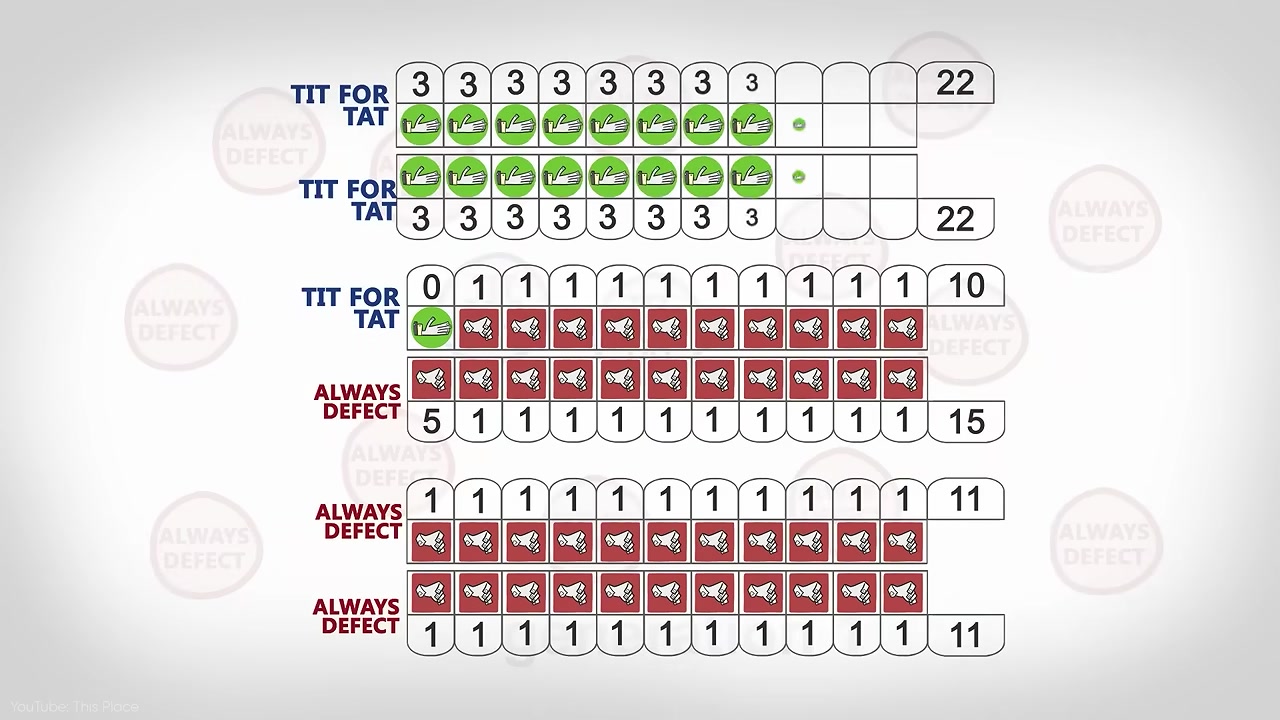
The famous tournament asked researchers to submit strategies for repeated play. The best-known winner was Tit for Tat, submitted by Anatol Rapoport: cooperate first, then copy the other player's previous move. The source video adds useful texture here: Axelrod's first tournament had 14 programs, 200 moves per match, five runs, and roughly a quarter million individual decisions. The simplest program beat the clever ones because it made four commitments visible. It was friendly at the start, firm after betrayal, quick to resume cooperation, and easy for another player to understand.
Those traits matter because cooperation fails through different kinds of weakness. A strategy that absorbs every betrayal becomes prey. A strategy that retaliates forever turns one wound into a permanent feud. A strategy that changes unpredictably prevents stable expectations. Axelrod's lesson is colder than "be nice." It is closer to: be good news to meet, expensive to exploit, and simple enough that others can coordinate with you.
Biology Found The Same Shape
Martin Nowak's "Five Rules for the Evolution of Cooperation" gives the larger biological frame. Cooperation can be supported by kin selection, direct reciprocity, indirect reciprocity, network reciprocity, and group selection. In practical terms, help can survive when relatives share genes, when partners meet again, when reputation travels, when cooperators cluster, or when more cooperative groups outperform less cooperative groups.
The video uses this ladder well because it moves cooperation below human ethics. Bacteria lack speeches about duty. They still coordinate. In quorum sensing, bacterial cells use chemical signals to adjust behavior based on population density. A 2023 Nature Communications paper frames quorum sensing as a way for bacteria to pool information and improve group decisions.
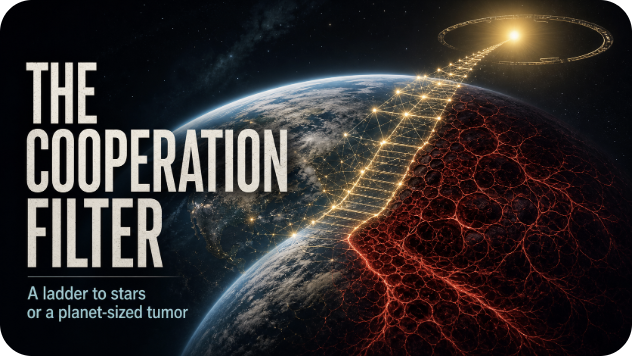
The important point is that coordination predates our stories about virtue. Life keeps rediscovering coordination because isolated extraction hits a ceiling. A cell that exits the contract of multicellularity can become cancer. It takes from the body as if only its own growth matters, then kills the host that made its growth possible. The image carries the article's core idea in physical form: local victory can become system-level suicide.

The AI Lab Version
The source video makes the AI section concrete by naming the race: OpenAI, Google DeepMind, Anthropic, xAI, and Chinese labs such as DeepSeek and Baidu. It says the leaders can publicly acknowledge existential risk while still accelerating every month, because unilateral restraint feels like surrender. That is the prisoner's dilemma with compute clusters instead of jail cells.
The payoff table is brutal. If both coordinate, the world gets a better chance at safety. If one coordinates while the other races, the racer may gain money, talent, prestige, and strategic advantage. If both race, capability may rise faster than governance. The video sharpens the difference from the Cold War: nuclear rivalry lasted decades, which gave treaties and deterrence time to form. A frontier AI race may have fewer rounds. The first lab to build a system beyond human-level strategic competence could change the game before everyone else gets a rematch.
This is why the video's AI chapter belongs beside nuclear weapons and climate. The Center for AI Safety statement placed AI extinction risk in the same public category as pandemics and nuclear war. People disagree about probabilities, timelines, and mechanisms, yet the coordination problem is already visible. Each actor can privately say: unilateral restraint may lose the race; collective acceleration may lose the world.
The policy implication is concrete. Safety talk has limited value when the payoff table rewards quiet defection. Shared evaluations, incident disclosure, third-party audits, deployment limits, model cards, and benchmark transparency are attempts to lengthen the shadow of the future. They make tomorrow's cost harder to hide inside today's advantage.
Institutions Are Future Machines
The midpoint of the argument is that cooperation works when the future has enough weight. The source video uses the "shadow of the future" to explain ordinary cheating. A taxi driver in a tourist city may overcharge a visitor he expects never to see again. A driver in a neighborhood with repeat customers has to live with the review, the memory, and the next ride. The future becomes a price signal.
Good institutions make the future heavier. Courts make retaliation predictable. Treaties make promises inspectable. Markets make reputation portable. Protocols make cooperation machine-readable. Source-control histories, public benchmarks, audit logs, and incident reports all perform a similar function inside technical organizations. They create memory, and memory changes incentives.
This is what the principle looks like inside an organization. The deciding variable is pressure survival: can the rule still bind people when the launch is late? A safety review that can be skipped under deadline pressure was never a constraint; it was decoration that felt like one. The mechanisms that actually change behavior all share one property: they outlast the moment of temptation. The future becomes real only when a decision made today is still legible, and still costly, after the deadline that tempted you has passed.
The Great Filter Suspicion
Robin Hanson's 1998 "Great Filter" essay asks why dead matter so rarely appears to become expanding, lasting life. The frame turns cosmic silence into a sequence of hard steps: life, complex cells, intelligence, technology, survival, expansion. Somewhere in that chain, perhaps, a transition is extremely rare.
Freeman Dyson's 1960 paper proposed looking for artificial infrared signatures from civilizations using stellar-scale energy. The Kardashev scale later gave popular language to civilizations classified by energy use. The Fermi paradox asks why an old, large galaxy shows so little settled evidence of advanced civilizations.
The cooperation filter is a conditional claim inside that larger puzzle. If technological intelligence commonly reaches dangerous power before it builds stable cooperation, then cooperation becomes one plausible bottleneck. The filter would appear wherever local advantage can destroy the shared system: nuclear competition, engineered pathogens, climate, runaway extraction, or AI races.
That frame needs discipline. Cancer, bacteria, geopolitics, AI labs, and Dyson spheres operate through different mechanisms. A reciprocal game strategy by itself leaves world politics unsolved. A bacterial signaling model stays far from an AI governance plan. The useful version of the lens asks a narrower question: where does short-term local gain create long-term system failure, and what architecture makes the future matter again?
The Cosmic Version
The video's final move is powerful because it shrinks the human self-image. Maybe the silence of the sky reflects more than distance, fuel, or radio windows. Maybe many worlds learn to split atoms, edit genomes, heat planets, and build artificial minds before they learn to maintain a durable cooperative contract.

That would make intelligence unstable in a specific way. It increases the prize for defection faster than it builds the architecture for restraint. A civilization becomes clever enough to stress its planet, its institutions, and its successor technologies, while still behaving like a short-term optimizer trapped inside a repeated game it refuses to recognize.
The result would be humiliating. Mind would be possible, even brilliant, yet brittle. It would flare, build dangerous tools, fracture under incentive pressure, and vanish before leaving a durable signature. The galaxy would stay quiet because many species solved intelligence before they solved cooperation.
What To Do With The Frame
The frame becomes useful only when it changes what we build. A lab, company, or government can ask the same retention test before a high-stakes decision: who can defect quietly, who sees the log, who pays the penalty, who can trigger rollback, and when does the next review happen? If the answer is vague, the cooperation story is theater. If the answer names an owner, a record, a cost, and a repair path, the next round has begun to discipline the current one.
I used to think of cooperation as an ethical preference. The better frame is that cooperation is how a system gains a future. At human scale, that sounds like character. At institutional scale, governance. At planetary scale, survival. At cosmic scale, it may decide whether a civilization turns its world into a launchpad or a tumor.
Earth is the ending image: a body with a new tissue called intelligence. If the tissue keeps the contract, the planet becomes the first rung of a ladder. If it breaks the contract, the sky stays quiet for a simple reason: something like us kept happening, briefly and brilliantly, then stopped there.
Read next → The AI Takeover Playbook: How We Could Lose Control by 2030
Max Petrusenko writes about AI agents, safety controls, and the incentives that decide whether powerful tools stay usable. Follow on Medium, X, or Substack.